Jaw clicking: is it always a problem?

Physiotherapist
Does your jaw click when you open your mouth, chew or yawn? Discover what may cause these sounds, when they might be a concern and in which situations Physiotherapy can help.
Hearing clicking sounds in your jaw when opening your mouth, chewing or yawning is relatively common and does not always mean that something is wrong. When these sounds are not accompanied by pain or difficulty moving the jaw, they generally do not require treatment. But when should you pay attention to them? In this article, we explain the possible causes of jaw clicking and the signs that may indicate the need for a Physiotherapy assessment.
What Is Jaw Clicking?
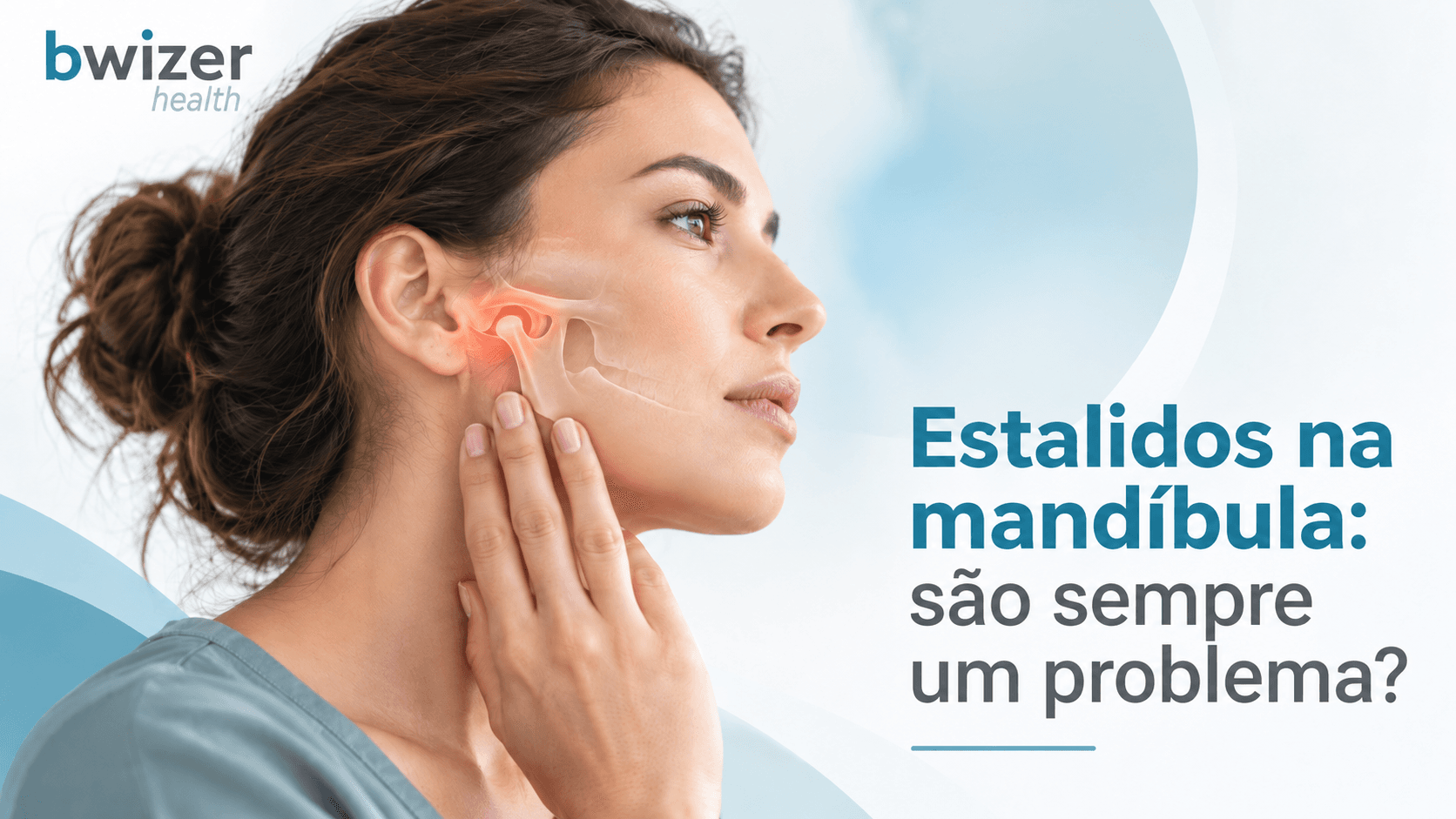
Jaw clicking refers to short, sharp sounds, similar to a click or pop, that may occur when opening or closing your mouth, chewing or yawning. These sounds originate from the temporomandibular joint (TMJ), located near the ear.
Other joint sounds may also occur, such as crepitus, which is characterised by a sound resembling sand rubbing together and may sometimes be associated with changes in the bony surfaces of the joint.
Why Does the Jaw Click?
The temporomandibular joint (TMJ) connects the jaw to the skull, allowing movements such as opening and closing the mouth, chewing and speaking. It consists of several structures, including the mandibular condyle (the end of the lower jawbone), the mandibular fossa of the temporal bone and the articular disc, which helps facilitate and coordinate these movements.
One of the most common causes of jaw clicking is related to the movement of this disc. In certain situations, the disc is displaced from its usual position and temporarily returns to a more normal relationship with the joint during mouth opening, producing a clicking sound. This phenomenon is known as disc displacement with reduction.
However, not all clicking sounds necessarily have this origin, and the presence of a joint sound alone is not enough to establish a diagnosis.
Does Jaw Clicking Mean There Is a Problem?
Not necessarily. Jaw clicking is relatively common, even among people who experience no pain or difficulty moving their jaw. Some studies suggest that joint sounds may be present in up to 50% of people without symptoms or functional limitations.
Although clicking may be associated with changes in the position or movement of the articular disc, these changes do not always cause symptoms or interfere with everyday activities.
The presence of a structural change in the joint does not necessarily mean that it is the source of the pain. In people with temporomandibular disorders (TMD), symptoms may be associated with several factors, including excessive strain on the chewing muscles, awake bruxism and the relationship between stress, jaw tension and pain.
In some people with chronic pain associated with TMD, there may also be changes in the way the nervous system processes pain, including central sensitisation — a phenomenon in which the nervous system becomes more sensitive to certain stimuli.
The relationship between the jaw and the cervical region also involves neurological mechanisms, particularly the trigeminocervical complex, where sensory information from the face and neck converges. This connection may contribute to symptoms occurring in both regions.
Furthermore, the presence of clicking does not mean that the condition will necessarily worsen. Some people continue to experience joint sounds even after recovering from pain or other functional limitations.
When Should Jaw Clicking Be a Cause for Concern?
Although jaw clicking is often harmless, certain associated symptoms may indicate a temporomandibular disorder (TMD) that requires assessment.
You should pay particular attention if the clicking is accompanied by:
- Pain in the jaw or near the ear, especially during jaw movements;
- Pain or difficulty when chewing, speaking or opening your mouth;
- Episodes in which the jaw becomes stuck or locked, making it difficult to open or close the mouth;
- Recurring headaches, particularly when associated with pain or tension in the jaw region.
In some situations, clicking may even disappear while significant difficulty opening the mouth develops, due to changes in the movement of the articular disc.
More important than the intensity or frequency of the clicking is whether there is pain, locking or functional limitation that interferes with everyday activities. In these cases, a clinical assessment can help identify the source of the symptoms and guide the most appropriate approach.
What Does a Clinical Assessment Involve?
During the consultation, the Physiotherapist seeks to understand when the symptoms first appeared, the circumstances in which they occur and how they affect activities such as chewing, speaking or yawning.
Another important aspect of the assessment is distinguishing symptoms associated with temporomandibular disorders from other possible causes of facial and jaw pain. These may include dental problems, ear or sinus conditions and, less commonly, neurological or vascular disorders. In certain situations, referral for a dental assessment may be necessary.
The assessment therefore helps determine whether treatment is needed and which approach is most appropriate for each individual.
How Can Physiotherapy Help?
When jaw clicking is associated with pain or difficulty moving the jaw, Physiotherapy for temporomandibular disorders can help relieve symptoms and improve jaw function.
Following an individualised clinical assessment, the Physiotherapist may use different strategies according to each person's needs:
- Therapeutic exercise: specific exercises designed to improve mobility, coordination and control of jaw movements.
- Manual therapy: techniques applied to the muscles and joints of the jaw and, when indicated, the cervical region, to help reduce pain and improve movement.
- Education and self-management strategies: guidance to help individuals understand their symptoms, identify habits that may contribute to discomfort and develop strategies to manage the condition in everyday life.
It is important to understand that the aim of Physiotherapy is not necessarily to eliminate clicking sounds, but to reduce pain, improve mobility and restore comfort during activities such as chewing, speaking or yawning.
When Should You Seek Help?
An isolated jaw click without pain or functional limitations is not, by itself, an indication for treatment.
Signs that justify assessment by a healthcare professional include:
- Persistent pain in front of the ear or in the chewing muscles;
- Difficulty or pain when chewing or speaking;
- Restricted mouth opening or episodes of jaw locking;
- Associated headaches.
Physiotherapy and Dentistry can play complementary roles in the assessment and management of temporomandibular disorders, helping to establish an approach tailored to each person's needs.
At Bwizer Health, we provide individualised assessments of jaw symptoms, seeking to identify their possible causes and improve function and comfort in everyday activities.
Book your Physiotherapy assessment at Bwizer Health.
Key Takeaways for You
- Jaw clicking does not necessarily mean there is a problem. When it does not cause pain or functional limitations, treatment is generally unnecessary.
- Clicking may be related to the movement of the articular disc. However, the presence of changes within the joint does not necessarily mean that pain or disease is present.
- Jaw pain can have several contributing factors. Muscle overload, teeth clenching, stress and changes in nervous system sensitivity are some of the factors that may be associated with it.
- Physiotherapy aims to improve pain and jaw function, not necessarily eliminate clicking. Recovery can occur even when joint sounds persist.
- Persistent pain, difficulty chewing or episodes of jaw locking justify a clinical assessment. These symptoms may indicate the need for professional care.
- Physiotherapy and Dentistry can complement each other. Collaboration between professionals allows for a more comprehensive assessment and an approach tailored to each person's needs.
References
Bednarczyk, V., Proulx, F., & Paez, A. (2024). The effectiveness of cervical rehabilitation interventions for pain in adults with myogenic temporomandibular disorders: A systematic review and meta-analysis. Journal of Oral Rehabilitation, 51(6), 1091–1107. https://doi.org/10.1111/joor.13671
Belenda González, I., Montero, J., Gómez Polo, C., & Pardal Peláez, B. (2025). Evaluation of the relationship between bruxism and/or temporomandibular disorders and stress, anxiety, depression in adults: A systematic review and qualitative analysis. Journal of Dentistry, 156, 105707. https://doi.org/10.1016/j.jdent.2025.105707
Busse, J. W., Casassus, R., Carrasco-Labra, A., Durham, J., Mock, D., Zakrzewska, J. M., Palmer, C., Samer, C. F., Coen, M., Guevremont, B., Hoppe, T., Guyatt, G. H., Crandon, H. N., Yao, L., Sadeghirad, B., Vandvik, P. O., Siemieniuk, R. A. C., Lytvyn, L., Hunskaar, B. S., & Agoritsas, T. (2023). Management of chronic pain associated with temporomandibular disorders: A clinical practice guideline. BMJ, 383, e076227. https://doi.org/10.1136/bmj-2023-076227
de Oliveira-Souza, A. I. S., de O. Ferro, J. K., Barros, M. M. M. B., & de Oliveira, D. A. (2020). Cervical musculoskeletal disorders in patients with temporomandibular dysfunction: A systematic review and meta-analysis. Journal of Bodywork and Movement Therapies, 24(4), 84–101. https://doi.org/10.1016/j.jbmt.2020.05.001
de Oliveira Souza, A. I. S., Raposo, J., da Silva, J. B., Vieira, M. A., Hahn, G., von Piekartz, H., & Armijo-Olivo, S. (2026). Physical therapy interventions for awake and sleep bruxism: What has been the approach over the last decades? A systematic review of the evidence and research gaps. Dental and Medical Problems, 63(3), 707–733. https://doi.org/10.17219/dmp/215136
Krasińska-Mazur, M., Homel, P., Gala, A., Stradomska, J., & Pihut, M. (2022). Differential diagnosis of temporomandibular disorders — a review of the literature. Folia Medica Cracoviensia, 62(2), 121–137. https://doi.org/10.24425/fmc.2022.141703
La Touche, R., Martínez García, S., Serrano García, B., Proy Acosta, A., Adraos Juárez, D., Fernández Pérez, J. J., Angulo-Díaz-Parreño, S., Cuenca-Martínez, F., Paris-Alemany, A., & Suso-Martí, L. (2020). Effect of manual therapy and therapeutic exercise applied to the cervical region on pain and pressure pain sensitivity in patients with temporomandibular disorders: A systematic review and meta-analysis. Pain Medicine, 21(10), 2373–2384. https://doi.org/10.1093/pm/pnaa021
Verhoeff, M. C., Lobbezoo, F., Ahlberg, J., Bender, S., Bracci, A., Colonna, A., Dal Fabbro, C., Durham, J., Glaros, A. G., Häggman-Henrikson, B., Kato, T., Koutris, M., Lavigne, G. J., Nykänen, L., Raphael, K. G., Svensson, P., Wieckiewicz, M., & Manfredini, D. (2025). Updating the bruxism definitions: Report of an international consensus meeting. Journal of Oral Rehabilitation, 52(9), 1335–1342. https://doi.org/10.1111/joor.13985