Chronic Pain and Temporomandibular Disorders
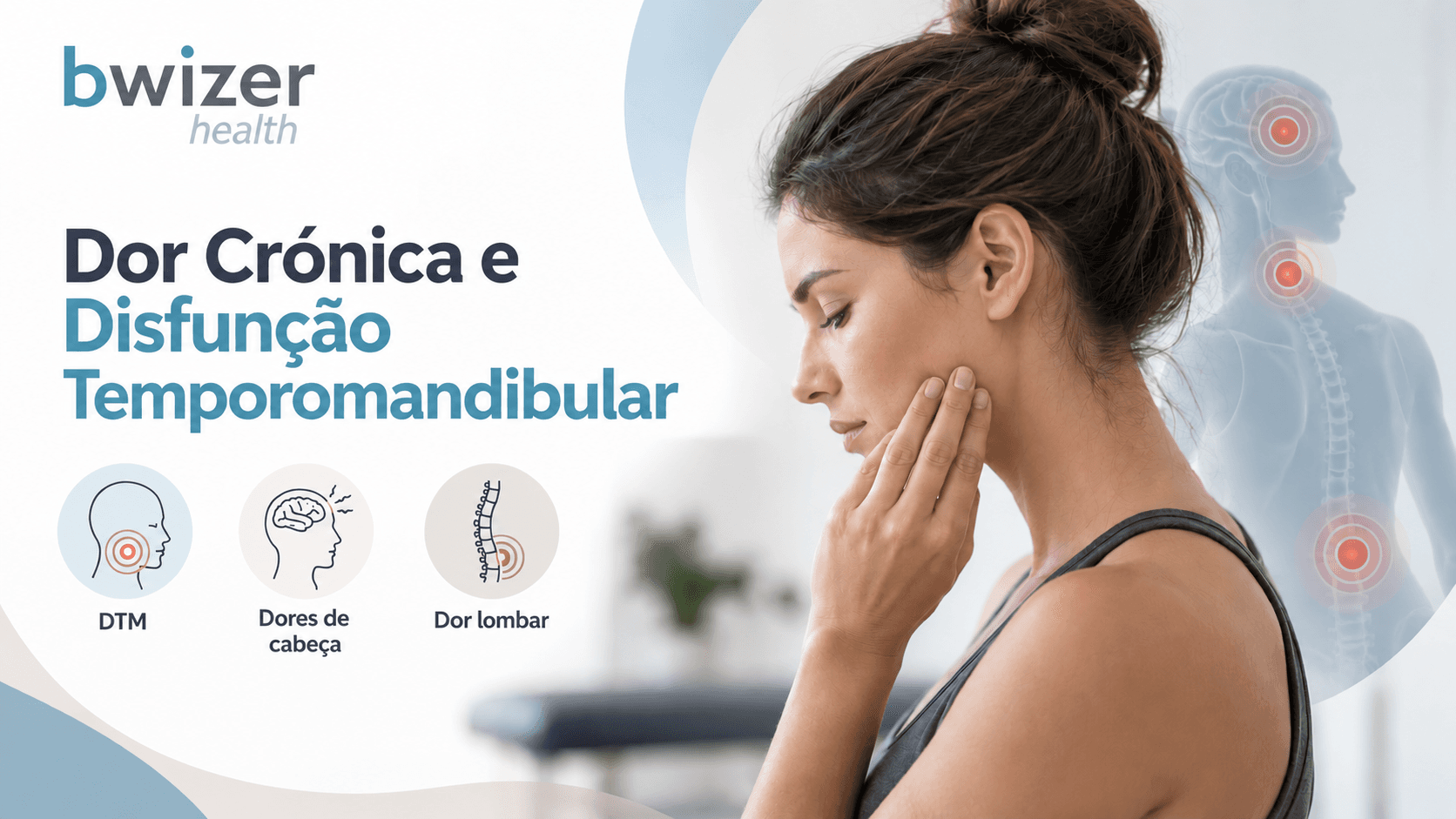
Temporomandibular Disorders (TMD) can be associated with persistent pain in other parts of the body, including the head, neck, or lower back. Understanding this connection helps explain why management may need to extend beyond the jaw.
Many people wake up with jaw tension, clicking when chewing, or facial pain and assume that the problem is purely dental or limited to the jaw joint. However, Temporomandibular Disorders (TMD) can often be accompanied by pain in other parts of the body, such as headaches, neck pain, and even chronic low back pain. Understanding how these symptoms may be connected and how best to manage them is the first step towards improving quality of life.
TMD and other pain conditions can coexist
TMD affects the temporomandibular joint (the “joint” connecting the mandible — commonly referred to as the jaw — to the skull) and the muscles involved in chewing. However, the available scientific evidence shows that, particularly in people with persistent pain, TMD can coexist with other painful conditions, such as headaches, neck pain, low back pain, fibromyalgia, or irritable bowel syndrome.
This coexistence of symptoms is often described as multisite pain or widespread pain.
How can jaw pain be related to back pain or headaches?
The answer lies in a nervous system phenomenon known as central sensitisation.
A simple way to understand this phenomenon is to imagine that the nervous system has a “volume control” for sensitivity. In some persistent pain conditions, the processing of stimuli can become more sensitive, as though this volume had been turned up.
This means that certain stimuli may trigger a stronger pain response than expected and that sensitivity may not remain limited to the area where the symptoms first began. In addition, the body’s natural mechanisms for “turning down” or relieving pain may not work as effectively, making relief more difficult to achieve.
This type of change in pain processing has been identified in some people with TMD. However, this does not mean that everyone with TMD has central sensitisation, nor that this mechanism alone explains all symptoms.
How can Physiotherapy help with TMD and Chronic Pain?
For people living with TMD and associated pain, Physiotherapy offers a conservative, safe, and person-centred approach to treatment.
When TMD is associated with persistent pain, treatment should be tailored to each person’s symptoms, functional limitations, and goals. Physiotherapy can form part of a conservative approach aimed at improving function and helping people manage their symptoms.
Depending on the assessment, strategies may include:
- Clinical exercise: exercises targeting the jaw and cervical region (and not only these areas), adapted to the person’s abilities and goals;
- Manual therapy: certain techniques targeting the cervical and orofacial regions may be used as part of treatment;
- Education and self-management: developing a better understanding of pain, identifying factors associated with symptoms, and developing strategies to manage everyday activities;
- Progressive return to function: gradually increasing the ability to perform activities that may be limited, such as chewing, speaking, or moving the head.
In more complex cases of persistent pain, or when other conditions are also present, coordination with other healthcare professionals may be necessary.
When might it be important to involve a Dentist?
Successful management of TMD and chronic pain may not depend on a single solution or healthcare professional, but rather on an integrated team approach.
A Dentist plays an important role in assessing oral health, the structures of the jaw, and other possible causes of symptoms, determining when a specific dental intervention may be appropriate.
When necessary, collaboration between Dentistry and Physiotherapy can help integrate the different factors that may be associated with the symptoms.
What can you do today?
Create a Pain Diary:
- Each day, record the exact location of your pain on a sheet of paper or simple body chart, its intensity, and the time of day when it occurs.
- Also note what seems to relieve or aggravate your symptoms and which everyday activities (such as chewing, speaking, or smiling) are limited.
Identify your habits:
- Pay attention to behaviours you may perform unconsciously during the day or while sleeping, such as grinding or clenching your teeth (bruxism), biting your nails or lips, or resting your chin on your hand.
Identifying these patterns and behaviours can provide useful information to your Dentist and Physiotherapist, supporting a more thorough assessment of your condition.
When should you seek professional help?
You should arrange an assessment with a Dentist and Physiotherapist specialising in Orofacial Pain in the following situations:
- Persistent or recurring pain (≥ 3 months) in the jaw, face, or neck without spontaneous improvement;
- Jaw pain accompanied by pain in other parts of the body, such as frequent headaches (including migraines), neck pain, or chronic low back pain;
- Significant difficulty opening your mouth, limited range of motion, painful clicking or joint sounds, or early muscle fatigue when chewing;
- Symptoms that affect sleep quality, cause high levels of anxiety or stress, or interfere with your personal or professional life.
Book your appointment at Bwizer Health.
It is important to seek immediate medical attention if facial or head pain is accompanied by symptoms such as fever, nasal obstruction and purulent nasal discharge; severe burning or electric shock-like pain in the face; or significant jaw fatigue accompanied by changes in vision in people over the age of 50.
This article is for informational purposes only and does not replace an individual assessment by a healthcare professional.
References
Bednarczyk, V., Proulx, F., & Paez, A. (2024). The effectiveness of cervical rehabilitation interventions for pain in adults with myogenic temporomandibular disorders: A systematic review and meta-analysis. Journal of Oral Rehabilitation, 51(6), 1091–1107. https://doi.org/10.1111/joor.13671
Bizzarri, P., Manfredini, D., Koutris, M., Bartolini, M., Buzzatti, L., Bagnoli, C., & Scafoglieri, A. (2024). Temporomandibular disorders in migraine and tension-type headache patients: A systematic review with meta-analysis. Journal of Oral & Facial Pain and Headache, 38(2), 11–24. https://doi.org/10.22514/jofph.2024.011
Busse, J. W., Casassus, R., Carrasco-Labra, A., Durham, J., Mock, D., Zakrzewska, J. M., Palmer, C., Samer, C. F., Coen, M., Guevremont, B., Hoppe, T., Guyatt, G. H., Crandon, H. N., Yao, L., Sadeghirad, B., Vandvik, P. O., Siemieniuk, R. A. C., Lytvyn, L., Hunskaar, B. S., & Agoritsas, T. (2023). Management of chronic pain associated with temporomandibular disorders: A clinical practice guideline. BMJ, 383, e076227. https://doi.org/10.1136/bmj-2023-076227
Justribó-Manion, C., Mesa-Jiménez, J., Caballero-Ruiz-de-la-hermosa, C., Zuil Escobar, J. C., & Armijo-Olivo, S. (2024). Is low back pain a risk/prognostic factor for the development and/or progression of temporomandibular disorders? A systematic review with meta-analysis. Journal of Oral Rehabilitation, 51(2), 427–454. https://doi.org/10.1111/joor.13601
Krasińska-Mazur, M., Homel, P., Gala, A., Stradomska, J., & Pihut, M. (2022). Differential diagnosis of temporomandibular disorders — A review of the literature. Folia Medica Cracoviensia, 62(2), 121–137. https://doi.org/10.24425/fmc.2022.141703
La Touche, R., Martínez García, S., Serrano García, B., Proy Acosta, A., Adraos Juárez, D., Fernández Pérez, J. J., Angulo-Díaz-Parreño, S., Cuenca-Martínez, F., Paris-Alemany, A., & Suso-Martí, L. (2020). Effect of manual therapy and therapeutic exercise applied to the cervical region on pain and pressure pain sensitivity in patients with temporomandibular disorders: A systematic review and meta-analysis. Pain Medicine, 21(10), 2373–2384. https://doi.org/10.1093/pm/pnaa021
Pelai, E. B., de Castro-Carletti, E. M., Tavares, L. F., Michelotti, A., Pitance, L., Rodrigues-Bigaton, D., Foltran-Meschollotto, F., Dennett, L., & Armijo-Olivo, S. (2026). Manual therapy and exercise targeted to the neck and orofacial regions for patients with orofacial pain: A systematic review and meta-analysis. Disability and Rehabilitation, 48(2), 286–330. https://doi.org/10.1080/09638288.2025.2539469
Qu, J., Qian, Y., Zhang, Y., Chen, B., Wang, R., Bao, J., Huang, X., & Lu, Y. (2025). Efficacy of manipulation and therapeutic exercise applied to the neck region of patients with temporomandibular disorders: A systematic review and meta-analysis. Journal of Stomatology Oral and Maxillofacial Surgery, 126(6S), 102530. https://doi.org/10.1016/j.jormas.2025.102530
Quilghini, C., Lefflot, J., & Buchholtz, K. (2025). The effectiveness of physiotherapy for chronic headaches in patients with temporomandibular disorders: A systematic review. Frontiers in Rehabilitation Sciences, 6, 1647927. https://doi.org/10.3389/fresc.2025.1647927