Preparing for birth: how movement and breathing can help

Physiotherapist
Physiotherapist no. 1501 OF · Ordem dos Fisioterapeutas
Last reviewed:
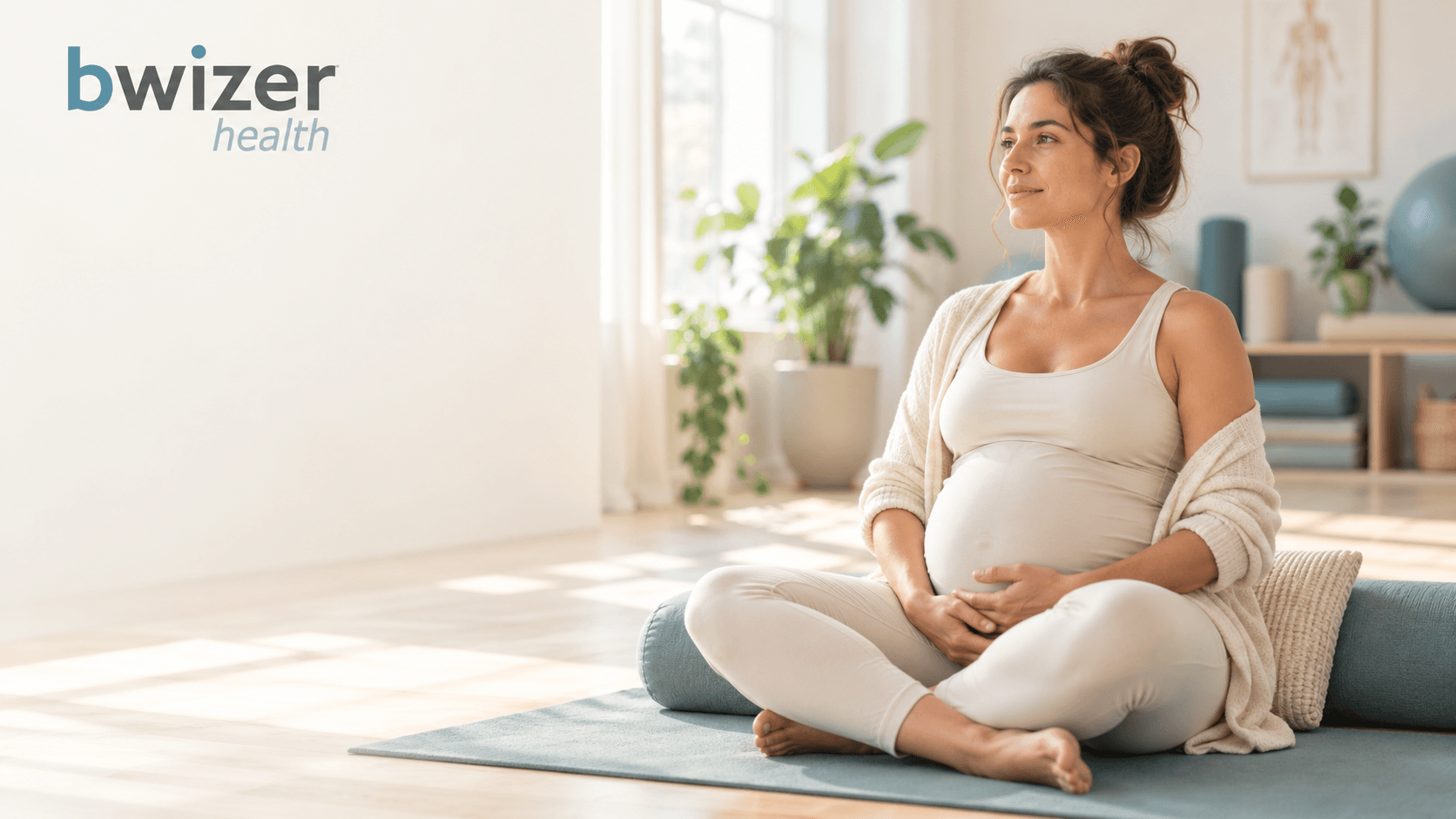
Exploring positions, breathing and ways to receive support can be part of preparing for birth. Find out what exercise, Pilates and pelvic floor care can offer, without promises of controlling the outcome of birth.
As birth approaches, it is natural to wonder what you can do to prepare. Is it worth trying different positions? Do you need to learn a special way to breathe? Can Clinical Pilates help? Exploring ways to move and find comfort can be part of that preparation. But no exercise allows you to control everything that happens during birth.
Preparing can help you understand your options, explain your preferences and ask for support. The aim is to give you more resources to take part in decisions, knowing that your needs and the plan may change.
What does preparing for birth through movement mean?
The term ‘functional preparation’ means exploring ways to move, change position, breathe and relax. It can include finding out which positions feel comfortable and how to ask for help to adapt them. These skills can be explored in an education or exercise session, taking your health into account.
For example, it may be useful to notice how you feel when changing position and which types of support make you more comfortable. You can also discuss what you would like to try during labour. Knowing the alternatives allows you to ask your maternity care team more specific questions.
Needs vary. Some women want information and would like to stay active. Others have pain that makes walking or resting difficult and may need an assessment. If there are pregnancy complications, you need to check with your healthcare team which activities are suitable before deciding what to do.
Is exercising during pregnancy the same as preparing for birth?
Exercise during pregnancy can help you stay active and maintain your ability to carry out everyday tasks. Recommendations apply to women without contraindications to the activity concerned, with adjustments throughout pregnancy. Labour has its own circumstances, which may change as it progresses.
Being able to do an exercise or hold a position during a class does not predict what your birth will be like. The positions and movements available at that time depend on your wishes, how labour progresses and the care available. What you have tried beforehand may give you some reference points, but you may need other options.
You can therefore think about your preferences without having to follow a set sequence of movements. What matters is understanding the possibilities and knowing how to discuss them. A change of plan during labour does not mean that your preparation was wasted.
Do you need to learn a breathing technique?
Breathing can be explored as a way to find comfort and relaxation. During a session, you can notice how you breathe while moving, pausing or changing position. Some ways of breathing may feel more comfortable than others.
The evidence gathered for this article does not identify a technique that guarantees a shorter labour, avoids a caesarean birth or prevents injuries to the perineum. Knowing how to breathe in a particular way does not give you control over all these outcomes.
Useful guidance should be easy to understand and allow for adjustments. If an instruction causes discomfort or is difficult to follow, tell the professional. During labour, the team may also guide your breathing according to what is happening. Being unable to maintain a technique you have learnt does not mean you are doing something wrong.
Does your pelvis need to be opened or aligned?
Exercises are often presented as ways to ‘open the pelvis’ or correct its alignment. These expressions can suggest that your body needs correcting for birth to happen. The research reviewed does not support that conclusion.
During pregnancy, the way you walk and move can change. These changes vary between women and do not, on their own, show that there is a problem with the position of the pelvis. Nor do they show that correcting posture determines whether birth will be vaginal or by caesarean.
How you feel when moving deserves attention. If a position is uncomfortable, it may need adapting. If pain limits your activities, an assessment can help clarify the problem and identify alternatives. Deciding what to do involves understanding your symptoms and difficulties, rather than assuming a ‘misalignment’.
How can Clinical Pilates be part of your preparation?
Clinical Pilates can be an exercise option during pregnancy when the programme suits the woman and her clinical circumstances. It can include movement, strength work, mobility and breathing. The content and the way sessions are supervised vary between programmes.
Some studies found improvements in pain in pregnant women who did Clinical Pilates. However, there were important differences between the studies and, in several cases, few participants. They do not establish that Clinical Pilates is better than other comparable exercise programmes.
Nor do they justify promising that Clinical Pilates prepares the pelvis for vaginal birth or reduces the need for a caesarean. Some programmes studied combined Clinical Pilates, education and breathing, so it is not possible to know how much each component contributed.
You may choose Clinical Pilates because you enjoy it and value the support. Before starting, find out how the class is adapted to pregnancy and what happens if symptoms arise. Your choice should take into account what you need and what you can do.
Does pelvic floor training prevent birth injuries?
The pelvic floor is a group of muscles involved in bladder control, among other functions. Training involves learning to contract and relax these muscles, with exercises adapted to the individual. Attending a Clinical Pilates class does not guarantee that this specific training takes place.
There is evidence that training these muscles during pregnancy can reduce the risk of urinary leakage in women who do not already have leakage. Preventing urinary leakage is, however, a different question from preventing injuries during birth. Greater muscle strength does not, on its own, mean that both outcomes are assured.
A review of studies found fewer severe perineal injuries in programmes that included pelvic floor training, either alone or combined with exercise. However, the results need to be interpreted cautiously: the programmes differed, and there were signs that studies with favourable results might have been overrepresented in the review. For episiotomy, no clear reduction was demonstrated.
These findings do not justify promising protection against injuries or recommending the same training for every pregnant woman. If you have pain or difficulty relaxing, doing more contractions may not be the right response. Guidance should start with your needs.
Can perineal massage help?
The perineum is the area between the vaginal opening and the anus. Perineal massage during pregnancy is an option you can discuss with your healthcare team. It is not an essential part of preparing for birth.
A Cochrane review, based on an older search for studies, found a small reduction in injuries requiring stitches and in episiotomies, particularly in women who had not previously given birth vaginally. An episiotomy is a cut made in the perineum during birth. The review did not demonstrate a clear reduction in the most severe tears, which affect the muscle that controls the passage of stools and, sometimes, the wall of the rectum.
This means there may be benefits for some outcomes, but massage does not guarantee that the perineum will remain uninjured. Its results should not be confused with those of muscle training: these are different interventions.
If you are considering it, ask whether it is suitable for your circumstances and clarify any questions before starting. Your comfort, preferences and previous experiences matter. You can decline or stop. If there is a suspected infection, bleeding, fluid leakage or another complication, clinical advice is needed before considering an intimate practice.
How can your birth companion help?
Your birth companion can start by listening to what makes you comfortable and how you would like to be helped. They can learn about your preferred positions and how to support communication with the team. They do not need to memorise exercises to be supportive.
It may be useful to talk beforehand: would you prefer reminders about a strategy, or would you rather they waited until you asked for help? How would you like them to communicate with the team when you are concentrating on labour? The answers are personal and may change on the day.
Preparation should help your companion respect these choices. Constantly correcting your breathing or insisting on a position may not be the support you want. Your wishes and clinical guidance should shape their involvement.
How do you choose a birth preparation session?
Find out whether the session is intended to provide information, explore movement or treat symptoms. These are different aims. Someone whose pain limits everyday life may need a separate assessment, even if they already attend antenatal classes.
Ask who leads the session, how activities are adapted and when contact with your maternity care team is recommended. If intimate techniques are offered, there should be an explanation, time for questions and freedom not to take part.
It also matters to know what the programme aims to help you develop. Understanding your options, finding comfortable positions and knowing how to explain a difficulty are goals that can be followed up. A promise to avoid caesareans or guarantee an ‘easy birth’ goes beyond what this evidence supports.
What can you do before your next appointment?
Start with the questions that matter most to you. You could make a note of a position that causes discomfort, a difficulty with movement or a question about breathing. Bringing specific examples helps the professional understand what you need to clarify.
If you already do exercise that is appropriate for your circumstances, notice how you respond to your usual activities without forcing movements to test your limits. An uncomfortable position can be changed or stopped. Significant pain or ongoing limitations warrant an assessment, rather than persisting with a sequence found online.
When speaking with the team, ask whether there are specific precautions, when you should stop an activity and which options for movement and support will be available where you plan to give birth. You can revisit these questions as your pregnancy progresses.
What if birth happens differently from what you expected?
Preparation can help you understand your options and ask for support, but birth depends on many factors. Even with support and practice, a caesarean, pain relief or another change of plan may be needed.
This does not mean you did not train enough or failed at a technique. The quality of preparation is not measured only by how you give birth. Understanding a recommendation, explaining a preference or being able to ask for clarification are also part of your involvement in care.
Frequently asked questions
Is there a position that every woman should use?
No. The options depend on preferences, clinical circumstances and the setting in which birth takes place. Knowing different positions can be useful, but it does not mean you must choose one in advance or maintain it despite discomfort.
Does Clinical Pilates replace antenatal classes?
Clinical Pilates can be part of exercise during pregnancy, but it does not replace information about birth and maternity care. Check what each programme includes and which questions you need to clarify with the team.
Should you persist with a position if you have pelvic pain?
You may need to change position, stop or seek an assessment. You should not persist simply because the movement is part of your preparation. New severe pain or pain accompanied by other symptoms requires appropriate care.
When should you seek help?
If pain makes walking, resting or changing position difficult, seek an assessment to understand which care or adjustments may help. Questions about exercise when there is a pregnancy complication should be clarified with your healthcare team before continuing.
If you experience bleeding, fluid leakage, new severe pain or other potentially serious warning signs, stop the activity and seek appropriate medical care. Do not wait for a reply on social media.
Would you like to clarify your questions about exercise and support during pregnancy? Book an assessment at Bwizer Health to discuss your needs and the next steps.
This article is for information only and does not replace an individual assessment. Exercises and intimate practices should take account of your clinical circumstances, preferences and consent.
References
American College of Obstetricians and Gynecologists. (2020). Physical activity and exercise during pregnancy and the postpartum period: ACOG Committee Opinion, Number 804. Obstetrics & Gynecology, 135(4), e178–e188. https://doi.org/10.1097/AOG.0000000000003772
Beckmann, M. M., & Stock, O. M. (2013). Antenatal perineal massage for reducing perineal trauma. Cochrane Database of Systematic Reviews, (4), Article CD005123. https://doi.org/10.1002/14651858.CD005123.pub3
Buran, G., & Erim Avcı, S. (2024). The effect of pregnancy pilates-assisted childbirth preparation training on urinary incontinence and birth outcomes: A randomized-controlled study. Archives of Gynecology and Obstetrics, 310(5), 2725–2735. https://doi.org/10.1007/s00404-024-07653-5
Dias, N. T., Ferreira, L. R., Fernandes, M. G., Resende, A. P. M., & Pereira-Baldon, V. S. (2018). A Pilates exercise program with pelvic floor muscle contraction: Is it effective for pregnant women? A randomized controlled trial. Neurourology and Urodynamics, 37(1), 379–384. https://doi.org/10.1002/nau.23308
Li, Y., Lu, H., Zhang, L., Ren, Y., Dai, X., & Lin, L. (2025). Pilates exercise in pregnancy: A systematic review and meta-analysis. BMC Sports Science, Medicine and Rehabilitation, 17, Article 20. https://doi.org/10.1186/s13102-025-01067-9
Mottola, M. F., Davenport, M. H., Ruchat, S.-M., Davies, G. A., Poitras, V. J., Gray, C. E., Jaramillo Garcia, A., Barrowman, N., Adamo, K. B., Duggan, M., Barakat, R., Chilibeck, P., Fleming, K., Forte, M., Korolnek, J., Nagpal, T., Slater, L. G., Stirling, D., & Zehr, L. (2018). 2019 Canadian guideline for physical activity throughout pregnancy. British Journal of Sports Medicine, 52(21), 1339–1346. https://doi.org/10.1136/bjsports-2018-100056
Song, C., Shen, Y., Tang, X., Li, Z., Li, X., Zhang, X., Xiang, Y., Ma, J., Tian, X., Li, H., Li, F., & Li, H. (2026). Pilates during pregnancy for maternal musculoskeletal pain and discomfort: A systematic review and meta-analysis. BMJ Open, 16(5), Article e112441. https://doi.org/10.1136/bmjopen-2025-112441
Woodley, S. J., Lawrenson, P., Boyle, R., Cody, J. D., Mørkved, S., Kernohan, A., & Hay-Smith, E. J. C. (2020). Pelvic floor muscle training for preventing and treating urinary and faecal incontinence in antenatal and postnatal women. Cochrane Database of Systematic Reviews, (5), Article CD007471. https://doi.org/10.1002/14651858.CD007471.pub4
Zhang, D., Bø, K., Montejo, R., Sánchez-Polán, M., Silva-José, C., Palacio, M., & Barakat, R. (2024). Influence of pelvic floor muscle training alone or as part of a general physical activity program during pregnancy on urinary incontinence, episiotomy and third- or fourth-degree perineal tear: Systematic review and meta-analysis of randomized clinical trials. Acta Obstetricia et Gynecologica Scandinavica, 103(6), 1015–1027. https://doi.org/10.1111/aogs.14744