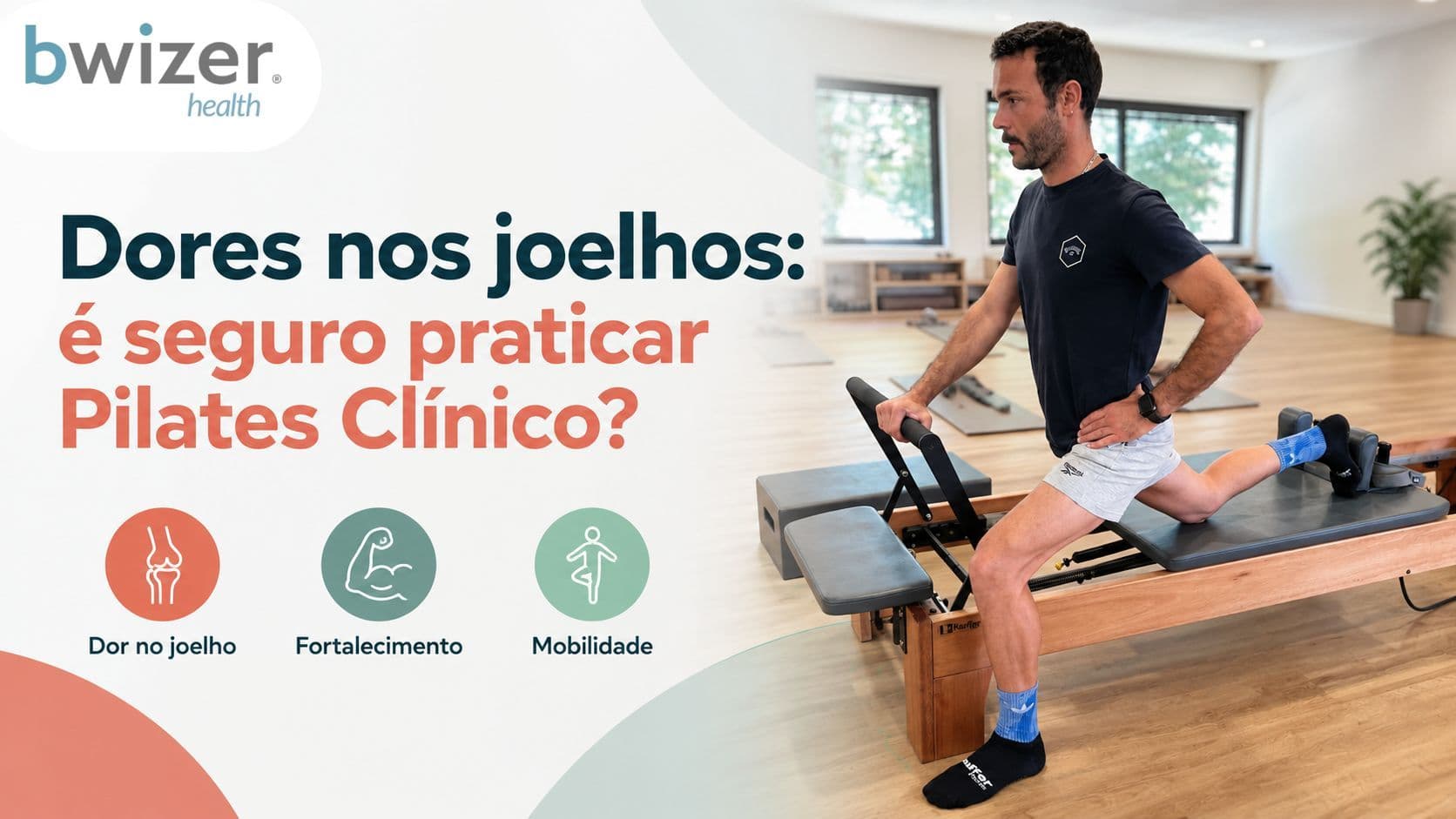
Knee Pain: is it safe to practice Clinical Pilates?

Among the various non-pharmacological treatment options available, Clinical Pilates, a clinical exercise method delivered by physiotherapists, has emerged as a promising and increasingly popular therapeutic intervention. But is this type of exercise safe for people who already experience pain, particularly joint pain?
Knee pain, frequently caused by osteoarthritis, ligament injuries, and other factors, is one of the leading causes of disability and reduced quality of life worldwide.
Among the various non-pharmacological treatment options available, Clinical Pilates, a clinical exercise method delivered by physiotherapists, has emerged as a promising and increasingly popular therapeutic intervention. But is this type of exercise safe for people who already experience pain, particularly joint pain?
Is Clinical Pilates safe for the knees?
Overall, scientific evidence indicates that Clinical Pilates is a safe, low-impact form of therapeutic exercise for people with chronic knee pain. Across several research reviews, no significant adverse effects have been reported as a result of its practice. As it allows exercise intensity to be adjusted and focuses on movement precision, the risk of injury is minimised.
However, experts emphasise an important consideration: although the practice is considered safe, exercises should be performed under the guidance of a physiotherapist. People who are more physically vulnerable should take particular care when performing intensive movements without supervision.
Benefits for people with knee pain
Clinical Pilates is not only safe but also highly effective in reducing pain and improving physical function. Its main benefits include:
- Pain reduction: Clinical Pilates is consistently more effective than performing no exercise or receiving health education alone in reducing pain.
- Muscle strengthening: the method focuses on strengthening the core and leg muscles, such as the quadriceps, helping to stabilise the joint and distribute loads more effectively across the knee.
- Improved balance and proprioception: the practice improves body awareness and balance, which is important both for preventing falls and for the rehabilitation of injuries such as partial anterior cruciate ligament (ACL) tears.
- Increased mobility: some studies suggest that Clinical Pilates may be more effective than conventional exercises in improving knee range of motion.
How does Clinical Pilates work?
At Bwizer Health, the safety of any form of physical exercise, including Clinical Pilates, is ensured by our physiotherapists through a structured rehabilitation process involving rigorous, scientifically informed assessment and monitoring.
To achieve positive outcomes, scientific evidence suggests programmes lasting 8 to 12 weeks, with a frequency of 2 to 3 sessions per week, each lasting approximately 60 minutes. However, every person is different and, as such, exercise prescription should be individualised and developed by the physiotherapist together with the patient.
In summary, if you experience knee pain, Clinical Pilates can be an excellent physiotherapy tool as part of your knee rehabilitation process, offering benefits that extend beyond physical health and positively impact your overall well-being.
References
Denham-Jones, L., Gaskell, L., Spence, N., & Pigott, T. (2021). A systematic review of the effectiveness of Pilates on pain, disability, physical function, and quality of life in older adults with chronic musculoskeletal conditions. Musculoskeletal Care, 20(1), 10–30. https://doi.org/10.1002/msc.1563
Gao, K., Tao, J., Liang, G., Gong, C., Wang, L., & Wang, Y. (2025). Comparative efficacy of mind–body exercise for pain, function, quality of life in knee osteoarthritis: a systematic review and network meta-analysis. Journal of Orthopaedic Surgery and Research, 20, 384. https://doi.org/10.1186/s13018-025-05682-7
Giummarra, M., Vocale, L., & King, M. (2022). Efficacy of non-surgical management and functional outcomes of partial ACL tears. A systematic review of randomised trials. BMC Musculoskeletal Disorders, 23, 332. https://doi.org/10.1186/s12891-022-05278-w
Luo, Y., Chen, X., Gong, H., Chen, L., Zhang, L., & Li, S. (2025). Efficacy of aerobic exercises for knee osteoarthritis: a network meta analysis of randomized clinical trials. Journal of Orthopaedic Surgery and Research, 20, 557. https://doi.org/10.1186/s13018-025-05973-z
Oliveira, T. M. D., Felício, D. C., Elias Filho, J., Castro, R. Q., Gomides, F. J. S., Pires, L. F. P., Fonseca, D. S., & Malaguti, C. (2025). Effect of Pilates exercise on health-related outcomes in patients with knee osteoarthritis: A systematic review and meta-analysis. International Journal of Rheumatic Diseases, 28, e70434. https://doi.org/10.1111/1756-185x.70434
Pan, R., Mi, A., & Cheng, H. (2026). Comparative efficacy of traditional and modern mind-body exercises in middle-aged and older adults with knee osteoarthritis: a network meta-analysis of randomized controlled trials. Frontiers in Medicine, 13, 1821838. https://doi.org/10.3389/fmed.2026.1821838
Raposo, F., Ramos, M., & Cruz, A. L. (2021). Effects of exercise on knee osteoarthritis: A systematic review. Musculoskeletal Care, 19(3), 399–435. https://doi.org/10.1002/msc.1538
Somaiya, K. J., Samal, S., & Boob, M. A. (2024). Physiotherapeutic intervention techniques for knee osteoarthritis: A systematic review. Cureus, 16(3), e56817. https://doi.org/10.7759/cureus.56817
Zhang, K., Li, Y., Zhao, F., Xie, X., Yan, S., Kong, D., Zhang, W., Zhou, J., & Ma, H. (2025). The efficacy and safety of pilates exercise in patients with knee osteoarthritis: a systematic review with meta-analysis of randomized controlled trials. Annals of Medicine, 57(1), 2540616. https://doi.org/10.1080/07853890.2025.2540616