Clinical Pilates for Dancers: Much More Than Flexibility

Dance injuries do not occur simply because of a lack of flexibility, but because of a loss of control during repeated movement under load — and that is precisely what Clinical Pilates is designed to address.
When Technique Fails Before Pain Appears
In dance, most injuries do not begin with a fall, a poor landing, or an obvious technical mistake. They begin much earlier — with the gradual loss of control, stability, and movement efficiency.
The literature in dance medicine is consistent: most injuries result from overuse mechanisms, with the repeated accumulation of microtrauma that exceeds the tissues’ capacity to adapt. In many cases, dancers continue training and performing for weeks or even months while experiencing subtle signs of dysfunction.
This is where Clinical Pilates stops being a complementary activity and becomes a clinical tool.
The Most Common Mistake: Confusing Mobility with Control
One of the most common misconceptions in dance training is assuming that range of motion is synonymous with movement quality.
In clinical practice, the opposite is often observed:
- Greater range of motion without control = greater risk of compensation
- Repeated compensation = joint overload
- Chronic overload = injury
This is particularly evident in the ankle-foot complex and the hip joint, where small alignment changes become amplified through thousands of weekly repetitions.
Clinical Pilates addresses this exact issue: the ability to control movement at the end range, where the risk is greatest.
What Clinical Pilates Really Trains in Dancers
More than stretching or isolated strength work, Clinical Pilates targets four critical dimensions of dance performance:
1. Lumbopelvic Control
Trunk stability is the foundation of all force transfer.
When it fails:
- The pelvis loses its neutral position
- The lumbar spine compensates through excessive extension or rotation
- The lower limbs absorb excessive load
This is directly associated with overload patterns in the lumbar spine, frequently described in dancers exposed to repetitive jumping and sustained extension movements.
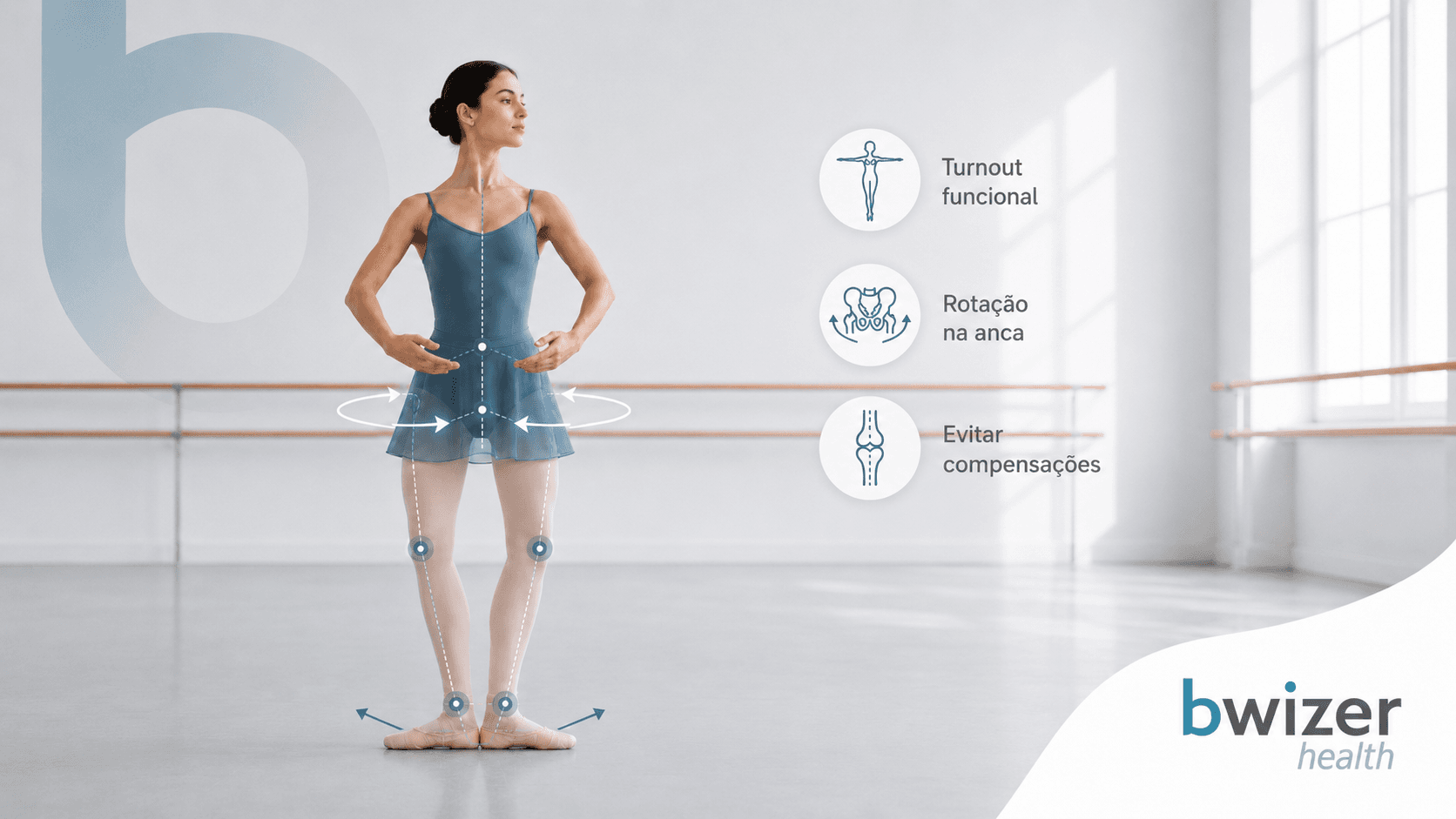
2. Functional Turnout Control
One of the most important factors in injury prevention in classical ballet is distinguishing between:
- Functional turnout (generated at the hip)
- Compensated turnout (generated through the knee and foot)
Clinical Pilates helps train hip external rotation without compromising distal alignment, reducing movement patterns such as:
- Overpronation
- Rotational tibial stress
- Patellofemoral overload
3. Ankle-Foot Complex Stability
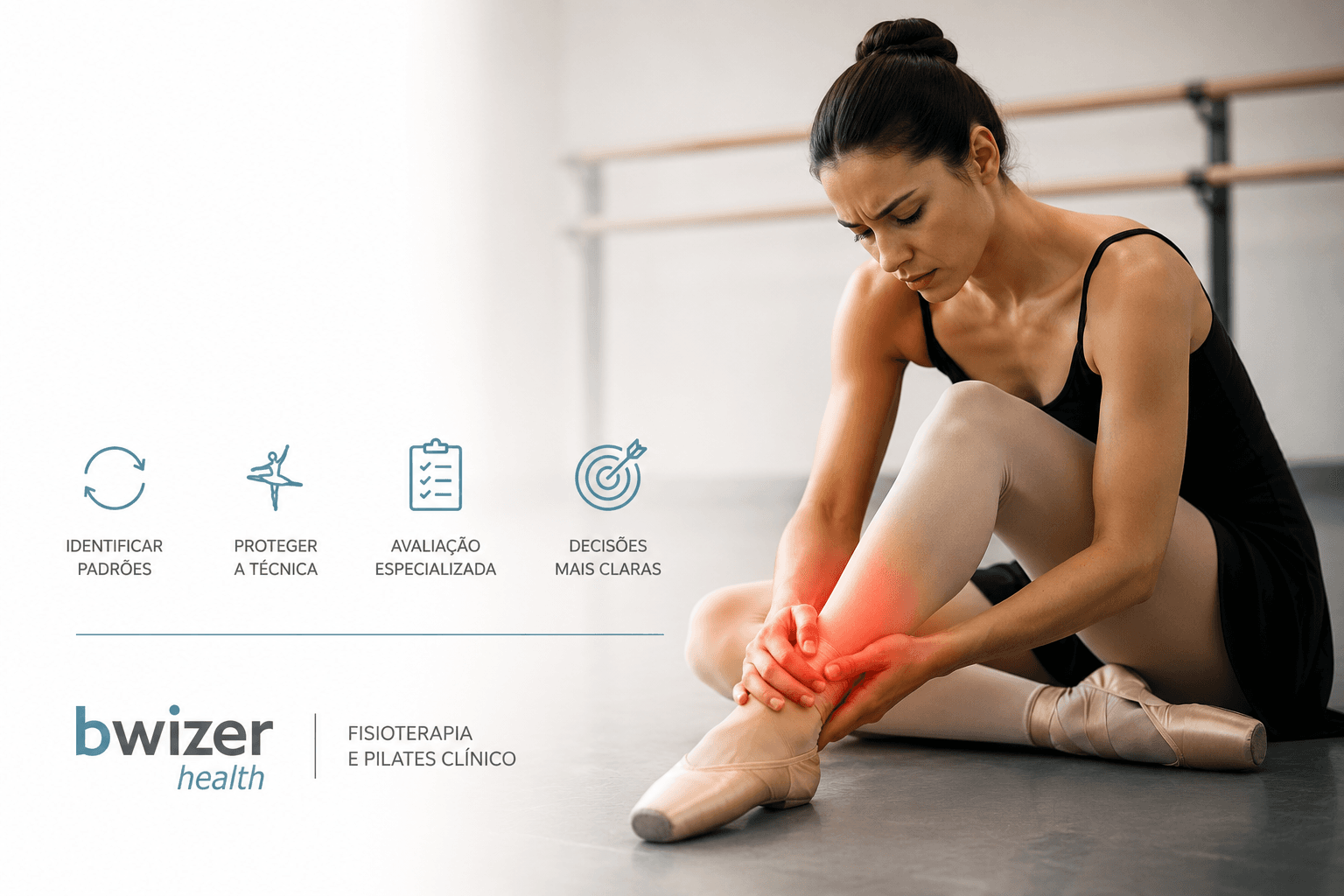
The ankle is one of the structures most commonly affected in dance, particularly during pointe work and repetitive jumping.
Subtle instability — often without initial pain — may present as:
- Trembling during relevé
- Loss of alignment
- The need to “grip the floor” with the toes
Clinical Pilates helps develop:
- Neuromuscular control
- Stability under progressive loading
- More efficient neuromuscular responses during landing
4. Impact Absorption Efficiency
A significant proportion of dance injuries occur during landing.
In repetitive impact situations, the literature describes forces that can reach several times body weight, particularly during consecutive jumps.
Clinical Pilates improves:
- Lower-limb kinetic chain alignment
- Segmental dissociation
- Eccentric control during deceleration
Clinical Pilates Is Not Stretching. It Is Control Under Load.
Reducing Clinical Pilates to flexibility alone overlooks its true impact on performance and injury prevention.
In dance, flexibility without control may actually increase risk. What protects a dancer is not the ability to go further, but the ability to return to centre with precision.
Who Benefits Most from This Approach?
Clinical and observational evidence in dance highlights distinct patterns of vulnerability:
- Female dancers: greater loading of the ankle-foot complex and hip, particularly during pointe work
- Male dancers: greater demands on lumbar stability and loading associated with jumps and lifts
- Both: a high prevalence of overuse injuries affecting the lower limbs
These differences reinforce the need for an individualised rather than a generic approach.
When Should Clinical Pilates Be Integrated into Training?
Ideally, Clinical Pilates should not be used only as a reactive intervention after injury. Instead, it should be integrated:
- As part of regular physical preparation
- As a weekly technical complement
- As an injury prevention strategy during periods of increased training load
- As a movement re-education tool following episodes of pain
👉 Download our free guide: 5 Clinical Pilates Exercises for Dancers
Conclusion: Prevention Is Career Longevity
Longevity in dance does not depend solely on talent, technique, or discipline. It depends on the ability to manage repeated loads without exceeding the body's adaptive limits.
Clinical Pilates offers a clear advantage: it enables dancers to continue doing what they love — with fewer compensations, greater efficiency, and better control.
At Bwizer Health, this approach is not aesthetic or accessory. It is clinical.
If you experience signs such as ankle instability, lower back pain after jumping, or a loss of technical control during repetitive movements, it may not simply be fatigue. It may be an emerging overload pattern.
👉 Complete the Bwizer Health Risk Calculator: Discover Your Dance Injury Risk
👉 Book a specialised biomechanical assessment: Dancer Clinical Assessment
References
Ahearn, E. L., Greene, A., & Lasner, A. (2018). Some effects of supplemental Pilates training on the posture, strength, and flexibility of dancers 17 to 22 years of age. Journal of Dance Medicine & Science, 22(4), 192–202. https://doi.org/10.12678/1089-313X.22.4.192
Amorim, T. P., Sousa, F. M., & Santos, J. A. R. (2011). Influence of Pilates training on muscular strength and flexibility in dancers. Motriz: Revista de Educação Física, 17(4), 660–666. https://doi.org/10.1590/S1980-65742011000400010
Che, L., Zhou, Y., & Wang, Y. (2025). Effects of 12-week Pilates Reformer training on the biomechanics of Latin dance Cha-Cha circle chasing technique. Frontiers in Physiology, 16, 1549389. https://doi.org/10.3389/fphys.2025.1549389
Critchley, M. L., Ferber, R., Pasanen, K., & Kenny, S. J. (2022). Injury epidemiology in pre-professional ballet dancers: A 5-year prospective cohort study. Physical Therapy in Sport, 58, 93–99. https://doi.org/10.1016/j.ptsp.2022.10.001
de Holanda Coêlho, E. P., dos Santos, F. S. L., Gomes, R. L. F., & Queiroz, I. P. (2025). O método Pilates na prevenção de lesões em bailarinas. In R. L. F. Gomes, I. P. Queiroz, & R. Alves (Eds.), Fisioterapia em evidência: Da teoria à prática (Vol. 1, pp. 26–32). Editora Poisson. https://doi.org/10.36229/978-65-5866-491-8.CAP.03
Hrubes, M. (2019). Return-to-dance strategies and guidelines for the dancer. In L. E. Elson (Ed.), Performing arts medicine (pp. 139–149). Elsevier. https://doi.org/10.1016/B978-0-323-58182-0.00015-8
Hrubes, M., & Janowski, J. (2021). Rehabilitation of the dancer. Physical Medicine and Rehabilitation Clinics of North America, 32(1), 1–20. https://doi.org/10.1016/j.pmr.2020.08.003
Junge, A., Hauschild, A., Stubbe, J. H., & van Rijn, R. M. (2024). Health problems of professional ballet dancers: An analysis of 1627 weekly self-reports on injuries, illnesses and mental health problems during one season. Sports Medicine - Open, 10, 79. https://doi.org/10.1186/s40798-024-00753-1
Kenny, S. J., Palacios-Derflingher, L., Whittaker, J. L., & Emery, C. A. (2018). The influence of injury definition on injury burden in preprofessional ballet and contemporary dancers. Journal of Orthopaedic & Sports Physical Therapy, 48(3), 185–193. https://doi.org/10.2519/jospt.2018.7542
Ljubojević, A., Gerdijan, N., Šebić, L., & Karalić, T. (2018). Pilates in sport dance training. Sportske Nauke i Zdravlje, 8(1), 101–109. https://doi.org/10.7251/SSH1801101LJ
Panhan, A. C., Gonçalves, M., Eltz, G. D., Villalba, M. M., Cardozo, A. C., & Bérzin, F. (2019). Effect of Pilates Mat exercises on neuromuscular efficiency of the multifidus and internal oblique muscles in a healthy ballerina. Journal of Dance Medicine & Science, 23(2), 80–83. https://doi.org/10.12678/1089-313X.23.2.80
Rinonapoli, G., Graziani, M., Ceccarini, P., Razzano, C., Manfreda, F., & Caraffa, A. (2020). Epidemiology of injuries connected with dance: A critical review on epidemiology. Medical Glasnik, 17(2), 256–264. https://doi.org/10.17392/1201-20
Shah, S., Weiss, D. S., & Burchette, R. J. (2012). Injuries in professional modern dancers: Incidence, risk factors, and management. Journal of Dance Medicine & Science, 16(1), 17–25. https://doi.org/10.1177/1089313X1201600103
Sun, Y., & Liu, H. (2024). Prevalence and risk factors of musculoskeletal injuries in modern and contemporary dancers: A systematic review and meta-analysis. Frontiers in Public Health, 12, 1325536. https://doi.org/10.3389/fpubh.2024.1325536
Tsartsapakis, I., & Zafeiroudi, A. (2026). Manual therapy, core training, and Pilates method interventions in dance rehabilitation: A scoping review. Healthcare, 14(7), 872. https://doi.org/10.3390/healthcare14070872
van Winden, D. P. A. M., van Rijn, R. M., Richardson, A., Savelsbergh, G. J. P., Oudejans, R. R. D., & Stubbe, J. H. (2019). Detailed injury epidemiology in contemporary dance: A 1-year prospective study of 134 students. BMJ Open Sport & Exercise Medicine, 5(1), e000453. https://doi.org/10.1136/bmjsem-2018-000453
Vera, A. M., Barrera, B. D., Peterson, L. E., Yetter, T. R., Dong, D., Delgado, D. A., McCulloch, P. C., Varner, K. E., & Harris, J. D. (2020). An injury prevention program for professional ballet: A randomized controlled investigation. Orthopaedic Journal of Sports Medicine, 8(7), 2325967120937643. https://doi.org/10.1177/2325967120937643
Yau, R. K., Golightly, Y. M., Richardson, D. B., Runfola, C. D., Waller, A. E., & Marshall, S. W. (2017). Potential predictors of injury among pre-professional ballet and contemporary dancers. Journal of Dance Medicine & Science, 21(2), 53–63. https://doi.org/10.12678/1089-313X.21.2.53